

If you are weighing RTX 5090 vs RTX 5080 for 1440p gaming, you are choosing between absolute flagship headroom and a premium high refresh sweet spot. Both GPUs are built on NVIDIA Blackwell architecture with DLSS 4 support, but they target very different power budgets, case requirements and long term upgrade plans.
This comparison focuses on the real decision for 1440p players, whether the extra tier of the RTX 5090 class is useful at 2560×1440 or whether the Graphics Cards favorite ASUS TUF Gaming GeForce RTX 5080 16GB GDDR7 OC already covers your monitor and leaves more room for the rest of your build.
This article contains affiliate links. If you buy through one of our links, CustomPCGaming may earn a commission at no extra cost to you. Commissions never influence which products we recommend or how we rank them. Read our Affiliate Disclosure for details.
Quick Picks at a Glance
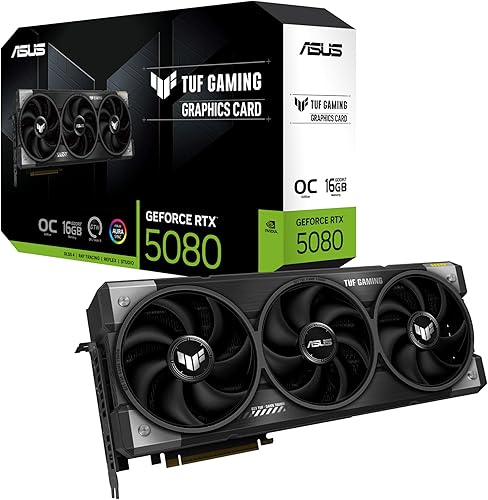
ASUS TUF Gaming GeForce RTX 5080 OC Edition 16GB
As an Amazon Associate we earn from qualifying purchases. Product prices and availability are accurate as of the date/time indicated.
Pros
- Exceptionally cool and quiet operation, even during demanding AAA gaming and sustained AI generation
- Excellent build quality with rugged TUF construction and included GPU support bracket to prevent sag
- Strong 4K gaming and local AI performance thanks to 16GB GDDR7 and DLSS 4
- Premium connectivity with DisplayPort 2.1a and HDMI 2.1b for high-refresh 4K and 8K displays
- Intuitive tuning and monitoring via GPU Tweak III software
Cons
- Massive 3.6-slot, 13.7-inch footprint requires a large case and may block adjacent PCIe slots
- Requires 850W PSU with 16-pin 12V-2x6 connector, so many upgraders will need a new power supply
- Minimal RGB lighting will disappoint builders seeking a flashy, highly customizable light show
The ASUS TUF Gaming GeForce RTX 5080 OC Edition is a flagship Blackwell graphics card built for serious gamers, creators and AI enthusiasts who demand uncompromising 4K performance. With 16GB of ultra-fast GDDR7 memory and DLSS 4, it is designed to handle the most demanding AAA titles and local AI workloads with ease.
In real-world use, owners report impressively low temperatures and near-silent operation, often staying under 60 degrees Celsius during extended Cyberpunk 2077 sessions and idling around 25 degrees. The factory overclock to 2730 MHz plus DLSS 4 delivers smooth, high-frame-rate 4K gaming, while 16GB GDDR7 proves excellent for ComfyUI video generation and other creative tasks.
Build quality is a true highlight, with a rugged TUF design featuring military-grade components, protective PCB coating and Auto-Extreme manufacturing for long-term reliability. The massive 3.6-slot fin array with three Axial-tech fans and a phase-change thermal pad ensures lasting cooling, and the included GPU holder helps prevent sag despite its 4.3-pound weight.
Its size is the main trade-off, as the 13.7-inch length and 3.6-slot width demand a large case with excellent clearance and slot spacing. You will also need an 850W power supply with a 16-pin 12V-2x6 connector, so many users upgrading from older 30-series cards should plan for a PSU upgrade as well.
Overall, the TUF RTX 5080 OC Edition delivers on its promise of durability, cool quiet power and next-gen features in a tank-like package. If you have the case space and power to support it, it is an outstanding choice for a high-end, future-proof gaming and creation rig that will stay reliable for years.
GPU: NVIDIA GeForce RTX 5080 Blackwell architecture, 16GB GDDR7, Boost Clock up to 2730 MHz in OC Mode and 2700 MHz in Default Mode, PCI-Express x16 interface.
Cooling and Power: Triple Axial-tech fans, 3.6-slot design with massive fin array, phase-change thermal pad, requires 850W PSU with 16-pin 12V-2x6 connector.
Connectivity and Build: 3x Native DisplayPort 2.1a, 2x Native HDMI 2.1b, max resolution 7680 x 4320, dimensions 13.7 x 5.7 inches, weight 5 pounds. Includes TUF graphics card holder, TUF magnet, Velcro hook and loop, and user manual. 3-year warranty.
How They Compare
We reviewed and compared these two Blackwell tiers on the factors that actually change a 1440p build, including performance positioning, memory capacity, power and PSU planning, and physical size. All specifics below come from the spec sheet for the ASUS TUF Gaming GeForce RTX 5080 16GB GDDR7 OC and qualitative positioning for the RTX 5090 class where no numeric data was provided.
Performance Tier and 1440p Positioning
The ASUS TUF Gaming GeForce RTX 5080 16GB GDDR7 OC is positioned as a high end 1440p and entry 4K card within the Blackwell stack. Per the spec sheet it offers an OC mode boost clock of 2730 MHz and a default mode of 2700 MHz, which owners commonly report translates to strong high refresh performance at 1440p with ray tracing and DLSS 4 enabled.
The RTX 5090 sits above that as the flagship tier, intended for gamers who want maximum headroom at 4K or for heavy ray tracing and creation workloads. For pure RTX 5090 vs RTX 5080 for 1440p gaming, that extra tier often goes underused unless you play at 240 Hz or higher, use extreme ray tracing presets, or plan to move to 4K soon, while the ASUS TUF Gaming GeForce RTX 5080 16GB GDDR7 OC already aligns with the refresh rates of most 1440p monitors.
VRAM Capacity and Future Headroom
Memory is a clear divider. The ASUS TUF Gaming GeForce RTX 5080 16GB GDDR7 OC ships with 16GB of GDDR7, which is the current sweet spot for 1440p ultra settings and comfortably handles modern texture packs and ray tracing at this resolution. If you want to see how this capacity compares to the next step down, our guide to the top RTX 5070 ti cards for 1440p gaming shows where 16GB lands in the broader 1440p lineup.
The RTX 5090 class is built with a larger VRAM pool than the 16GB found on the ASUS TUF Gaming GeForce RTX 5080 16GB GDDR7 OC, which helps in 4K, heavy modding and professional workloads that spill beyond gaming textures. For strictly 1440p gaming, that additional capacity is more about long term cushion than an immediate need, and most 1440p players will not hit a VRAM limit on the 5080 before they hit a GPU core or CPU limit.
Power Draw and PSU Planning
Power planning is where your build decision gets practical. The ASUS TUF Gaming GeForce RTX 5080 16GB GDDR7 OC lists a minimum 850W PSU with a 16-pin 12V-2×6 connector required, so you should verify your PSU model, cable and wattage before purchasing. You should also allow headroom over the combined GPU and CPU draw and follow the GPU maker recommended wattage rather than sizing to the edge, and never assume a PSU handles any card without checking its spec.
The RTX 5090 class draws more power and will call for a higher wattage PSU and more robust power delivery than the 850W minimum specified for the ASUS TUF Gaming GeForce RTX 5080 16GB GDDR7 OC. That means a more premium PSU, stricter cable management for the 12V-2×6 connection, and extra attention to case airflow, while the 5080 is easier to fit into an existing high end build without a full power system overhaul. If you are budgeting the whole system, the Budget Build Guides can help you balance PSU and GPU spend.
Size, Cooling and Case Fit
The ASUS TUF Gaming GeForce RTX 5080 16GB GDDR7 OC is a large card that demands case clearance planning. It measures 348mm in length, occupies 3.6 slots, weighs 4.3 lbs and includes a GPU bracket, with a massive fin array fed by three Axial-tech fans and a phase-change GPU thermal pad designed to outlast traditional paste under heavy loads.
The RTX 5090 class is generally even larger and heavier, with thicker coolers that can exceed the 3.6 slot thickness and 348mm length of the ASUS TUF Gaming GeForce RTX 5080 16GB GDDR7 OC. Both cards need you to confirm case clearance, slot spacing and GPU support, and to follow the manufacturer mounting instructions with proper anti-static handling, but the 5080 is slightly more forgiving in mid tower cases while the 5090 often requires a full tower or a carefully selected airflow case.
Which One Should You Get
Choose the RTX 5090 if you play at 1440p on a 240 Hz or 360 Hz monitor and want to push ray tracing to its highest presets without compromise, or if you know you will move to 4K within the next upgrade cycle and want a single GPU to cover both resolutions. It is also the better fit if your workflow includes creation tasks that benefit from the larger VRAM pool and flagship core count, and you have already budgeted for a higher wattage PSU, a large case with strong airflow, and the more premium choice overall.
Choose the ASUS TUF Gaming GeForce RTX 5080 16GB GDDR7 OC if your primary target is high refresh 1440p gaming with excellent ray tracing and DLSS 4 support without the flagship power and size penalty. It gives you 16GB GDDR7, a 2730 MHz OC boost clock, military-grade components and protective PCB coating for durability, plus a cooler that is still large at 348mm and 3.6 slots but easier to accommodate than the flagship class, all while staying on the recommended 850W PSU baseline.
Who Should Skip Both
Both of these Blackwell tiers are not ideal for compact small form factor builds, 1080p focused systems, or budget first PCs where a mid range GPU makes more sense. If you use a small case with limited GPU length or slot clearance, have a PSU well below the 850W minimum noted for the ASUS TUF Gaming GeForce RTX 5080 16GB GDDR7 OC, or mostly play competitive titles at 1080p, neither card is a good fit and you will get better value from a smaller, lower wattage option that matches your platform, as seen in builds like the ryzen 5 7600 RX 7700 XT 1000 dollar gaming PC amazon build.
Frequently Asked Questions
Is the RTX 5090 overkill for 1440p gaming compared to the RTX 5080?
For most 1440p gamers the RTX 5090 is more than needed, since the ASUS TUF Gaming GeForce RTX 5080 16GB GDDR7 OC already targets high refresh 1440p with DLSS 4 and 16GB GDDR7. The flagship makes sense mainly if you chase very high refresh rates, maxed ray tracing, or plan to jump to 4K soon.
How much PSU do I need for RTX 5080 vs RTX 5090 at 1440p?
The ASUS TUF Gaming GeForce RTX 5080 16GB GDDR7 OC specifies a minimum 850W PSU with a 16-pin 12V-2×6 connector, and you should add headroom for your CPU and other components. The RTX 5090 class requires more than that, so follow the maker recommendation for that tier and verify your PSU model and cable before you buy.
Will the ASUS TUF RTX 5080 fit in my case for a 1440p build?
The ASUS TUF Gaming GeForce RTX 5080 16GB GDDR7 OC is 348mm long, 3.6 slots thick and weighs 4.3 lbs, with a bracket included, so you must confirm case length clearance and slot spacing. The RTX 5090 class is typically larger, so if the 5080 is already tight, the flagship is not recommended for that chassis.


Write Your Review
No reviews yet. Be the first to share your experience!