

Asking is the Corsair RM850e a good PSU for an RTX 5070 gaming build is really asking how to balance power, connectors, and future headroom without overspending. You want stable power for your graphics card and CPU at your target resolution and refresh rate, with enough margin for transient spikes and upgrades, while keeping noise, efficiency, and cable management under control.
In September 2026, that choice comes down to five variables you can map before you buy: your resolution and refresh target, your CPU platform and socket, your case size and clearance, your total power budget with headroom, and whether you plan to keep this configuration or upgrade to a more demanding GPU or CPU later. If you clarify those first, the rest of the decision becomes much easier, and you can evaluate any Power Supplies option against your actual needs instead of marketing claims.
What Actually Matters
Wattage Headroom and GPU Maker Guidance
Start with the combined draw of your GPU and CPU, then add headroom. Power supplies are most comfortable when they are not constantly near their limit, and modern GPUs can create brief transient spikes above their typical draw. A good rule is to total your main components, add a comfortable margin, and then compare that figure to the GPU maker recommended wattage for your specific card.
You should always follow the GPU maker recommended wattage and the guidance in your GPU and motherboard manuals, and never assume a unit can handle any card. According to owners and per the spec sheet, many builders choose 750W to 850W for current high end single GPU gaming systems to keep that margin, but your exact need depends on your CPU choice, overclocking plans, number of drives and fans, and whether you will move to a higher power GPU later. If you are on the edge, moving up a tier is usually quieter and more flexible than running tight.
ATX 3.1 and PCIe 5.1 Compliance and Cabling
The newest standard matters for modern builds. ATX 3.1 with PCIe 5.1 compliance means the supply is designed to handle the transient power excursions that current GPUs can produce, up to 2x excursions as defined by the standard, and it includes the native 12V-2×6 connector that replaces the older 12VHPWR approach with improved reliability. That native cable reduces the need for adapters and helps with clean routing.
Also consider modularity. A fully modular design lets you connect only the cables your system requires, which improves airflow and makes building easier, especially in compact cases. When you research a unit, confirm it includes the native 12V-2×6 cable in the box, check the number of PCIe and EPS cables for your motherboard and GPU, and review cable length against your Cases & Airflow choice so you are not stretching cables in a large tower or crowding a small one.
Efficiency, Noise, and Component Quality
Efficiency ratings tell you how much power is wasted as heat. A Cybenetics Gold efficiency rating, for example, indicates solid efficiency at typical loads, which helps with heat and operating cost over time. Higher efficiency often correlates with less heat inside the case, which can help your overall system stay cooler and quieter.
Noise and longevity come from the fan and internal components. A 120mm rifle bearing fan with a tuned fan curve can keep noise down even when operating at full load, and many designs stay quiet at low to moderate loads. For reliability, look for 105C rated capacitors and protections that deliver steady, dependable electrical performance. If a quiet build is your priority, you may also want to explore quiet gaming PC cases that stay cool without the noise to pair a low noise PSU with a case that supports it.
Modularity, Size, and Case Compatibility
Physical fit is easy to overlook. Most ATX supplies share a standard width and height, but depth varies, and that depth can conflict with drive cages, shrouds, or cable space in smaller cases. Before you buy, check your case manual for maximum PSU length and compare it to the spec sheet. Also confirm you have room to route the thicker 12V-2×6 cable without sharp bends.
Modern Standby compatibility is another small but useful detail if you use sleep states frequently, as it supports extremely fast wake from sleep times and better low load efficiency. Fully modular cabling also helps here, because you can reduce clutter behind the motherboard tray and improve front to back airflow, which is especially valuable if you are following guidance like how to choose an airflow case for a hot GPU for a hot running graphics card.
To show how these criteria look in a real product, here are a few options that show the range:
This article contains affiliate links. If you buy through one of our links, CustomPCGaming may earn a commission at no extra cost to you. Commissions never influence which products we recommend or how we rank them. Read our Affiliate Disclosure for details.
Quick Picks at a Glance

Prime CORSAIR RM850e 850W Fully Modular ATX 3.1 PSU
As an Amazon Associate we earn from qualifying purchases. Product prices and availability are accurate as of the date/time indicated.
Pros
- ATX 3.1 and PCIe 5.1 ready with included native 12V-2x6 cable and adapter
- Fully modular design greatly simplifies cable management and airflow
- Very quiet cooling with optimized 120mm rifle bearing fan curve
- High-quality 105C rated capacitors and Cybenetics Gold efficiency
- Compact 140mm length and strong 7-year warranty
Cons
- 850W may be more than needed for budget or mid-range builds
- Only one dedicated PCIe 8-pin cable included, relies on adapter for additional connectors
- No RGB lighting or advertised zero-RPM fan mode for silent idle operation
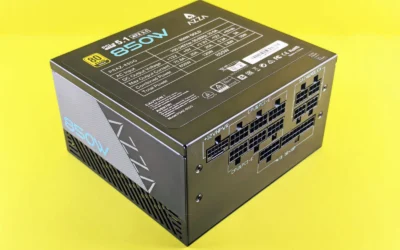
The CORSAIR RM850e (2025) is an 850W fully modular ATX power supply built for gamers, creators and anyone upgrading to RTX 40 series or newer GPUs. With ATX 3.1 and PCIe 5.1 compliance, it is ideal for high performance builds that need stable power and next generation connectors.
Its native 600W 12V-2x6 connector powers modern graphics cards without messy adapters, while support for 2x transient power excursions keeps your system stable during sudden GPU spikes. Cybenetics Gold efficiency and Modern Standby support improve low load efficiency and enable fast wake times, and the tuned 120mm rifle bearing fan stays quiet even under heavy load.
Design and build quality are standout strengths for this price class. At just 140mm long it fits easily in most mid tower and compact ATX cases, and fully modular cables keep builds tidy with better airflow. Industrial grade 105C rated capacitors ensure consistent electrical performance and long term reliability.
There are a few trade offs to consider. The included cable set is lean with only one native PCIe 8-pin cable plus a 12V-2x6 to dual 8-pin adapter, so users with multiple older GPUs may need extra cables. It also focuses on performance over aesthetics, with no RGB and no dedicated zero RPM mode for complete silence at idle.
Overall, the RM850e 850W hits an excellent balance of efficiency, compatibility and quiet operation for modern high end PCs. If you want a compact, future ready and dependable power supply that will handle demanding hardware for years, it is a smart and durable choice.
Model: CORSAIR RM850e (2025) CP-9020296-NA | Wattage: 850W | Form Factor: ATX | Modular: Fully Modular
Compliance: Intel ATX 3.1, PCIe 5.1 with native 12V-2x6 connector | Efficiency: Cybenetics Gold | Capacitors: Industrial-grade 105C rated
Cooling: 120mm rifle bearing fan with low-noise curve | Dimensions: 5.91 x 5.51 x 3.35 inches | Weight: 3.4 pounds
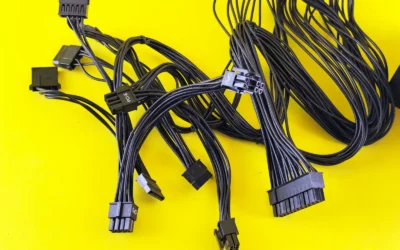
Connectors Included: 1x 24-pin ATX, 2x 8-pin EPS12V (4+4-pin), 1x PCIe 8-pin (6+2-pin), 1x 600W 12V-2x6, 1x 12V-2x6 to dual 8-pin adapter, 6x SATA, 2x PATA | Warranty: 7 Years
Matching a Part to Your Build
If you are planning a 1440p high refresh build with an RTX 5070 and a modern mid range to high end CPU, an 850W ATX 3.1 unit is a sensible middle ground for many gamers. The CORSAIR RM850e (2025) ATX 3.1 PCIe 5.1 Ready 850W fits this scenario well because it provides that 850W capacity, ATX 3.1 and PCIe 5.1 compliance with a native 12V-2×6 connection, Cybenetics Gold efficiency, and a 120mm rifle bearing fan that owners commonly report stays quiet under gaming loads. You get headroom for transient spikes and extra fans or storage without moving to a much larger capacity that you may not need.
If you are building in a compact mid tower or a case with limited PSU depth, focus on modularity and cable length. The CORSAIR RM850e (2025) ATX 3.1 PCIe 5.1 Ready 850W uses fully modular cabling so you only connect what you need, which helps in tight spaces and keeps airflow paths clear. Measure your case clearance, confirm the PSU length, and plan your 12V-2×6 routing so the cable has a gentle bend to the GPU. This is also where pairing with an airflow focused case pays off, since clean cabling directly supports GPU cooling.
If your priority is a quiet system that still has upgrade flexibility, look at noise and component quality alongside wattage. The CORSAIR RM850e (2025) ATX 3.1 PCIe 5.1 Ready 850W is rated for low noise operation with its rifle bearing fan curve and uses 105C rated capacitors for steady power delivery, plus Modern Standby support for efficient low load behavior. For you, 850W offers a comfortable buffer if you later move to a more power hungry GPU or add a higher core count CPU, while keeping fan speeds moderate today. If you know you will stay with a lower power CPU and will not upgrade the GPU for several years, you could evaluate a lower wattage alternative, but you would trade that future margin for a smaller initial outlay.
Common Mistakes
Buying too tight on wattage. It is common to match the PSU exactly to the current estimated draw and forget headroom. That leaves little room for transient spikes, additional drives and fans, or a future GPU upgrade. Always total your CPU and GPU draw, add margin, and follow the GPU maker recommended wattage instead of trying to save a small amount up front.
Ignoring case and cable fit. Even if wattage is correct, a PSU that is too deep for your case, or cables that are too short or too stiff for your routing, creates a frustrating build. Check PSU length against your case spec, confirm you have the right number of EPS and PCIe connectors for your motherboard and GPU, and make sure the native 12V-2×6 cable can reach with a smooth bend.
Chasing capacity you do not need or overlooking efficiency and noise. More watts is not automatically better if it means extra cost, heat, or noise for a system that will never use it. At the same time, do not ignore efficiency, fan design, and capacitor quality. A well built Gold efficiency unit with a quiet fan curve and reliable components often provides a better daily experience than a higher wattage unit with lower build quality.
Who Should Wait or Buy Differently
An 850W ATX 3.1 supply is not ideal for every build. If you are assembling a compact small form factor system that requires an SFX or SFX-L unit, a standard ATX PSU is not the right choice regardless of wattage. It is also not a good fit if your current parts list is very modest and you have no plans to upgrade, where a lower wattage Gold rated unit would be more cost effective, or if you are planning a future move to a very high power flagship GPU and overclocked CPU where you should assess a higher capacity tier and confirm your case and cooling can support it. If you are unsure, map your power budget first and wait until your GPU and CPU choices are final before you lock in the PSU.
Frequently Asked Questions
Is 850W enough for an RTX 5070 gaming build?
For many RTX 5070 builds with a modern CPU, 850W provides comfortable headroom for gaming, transient spikes, and typical accessories when you follow the GPU maker recommended wattage. Your exact need depends on your CPU, number of drives and fans, and upgrade plans, so total your components and keep a margin rather than sizing to the minimum.
Do I need ATX 3.1 and a native 12V-2×6 cable for an RTX 5070?
You do not strictly need it to power the system if you have the correct adapters, but ATX 3.1 with PCIe 5.1 compliance and a native 12V-2×6 connector is recommended for current GPUs. It is designed to handle transient excursions and provides a cleaner, more reliable single cable connection to the graphics card without adapters.
Will the CORSAIR RM850e (2025) ATX 3.1 PCIe 5.1 Ready 850W be quiet in a gaming PC?
Per the spec sheet it uses a 120mm rifle bearing fan with a specially calculated fan curve to keep noise down even at full load, and owners commonly report quiet operation at typical gaming loads. Noise also depends on your case airflow, fan curves, and total system load, so pair it with good cable management and airflow for the best result.

Write Your Review
No reviews yet. Be the first to share your experience!