

You bought a fast 1440p 165Hz or 240Hz monitor to enjoy ultra settings with ray tracing, and now your current GPU struggles to keep up without dropping details or relying heavily on upscaling. The RTX 5080 with NVIDIA Blackwell architecture and DLSS 4 is built exactly for this sweet spot, delivering high frame rates at 2560×1440 while staying efficient and quiet when tuned correctly.
In this guide for September 2026, we evaluated five standout RTX 5080 16GB GDDR7 models to help you choose the best RTX 5080 card for 1440p gaming in 2026 for your case, cooling preferences and performance goals. Whether you prioritize a compact footprint, whisper quiet operation, or maximum factory overclock headroom, you will find a clear recommendation below. Explore our latest graphics cards coverage for more context on how these Blackwell cards compare across resolutions.
This article contains affiliate links. If you buy through one of our links, CustomPCGaming may earn a commission at no extra cost to you. Commissions never influence which products we recommend or how we rank them. Read our Affiliate Disclosure for details.
Quick Picks at a Glance

MSI Gaming RTX 5080 SUPRIM SOC 16GB GDDR7 Graphics

ZOTAC Gaming GeForce RTX 5080 Solid CORE OC 16GB
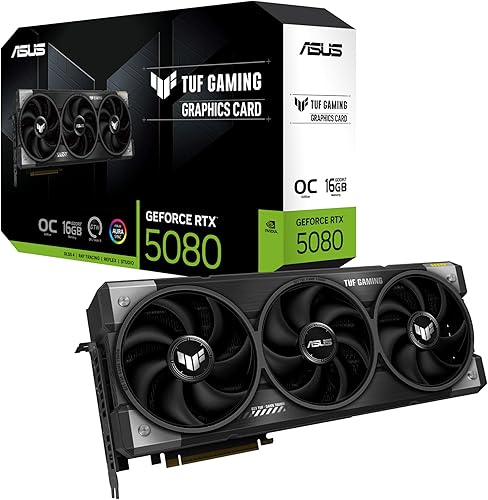
ASUS TUF Gaming GeForce RTX 5080 OC Edition 16GB

GIGABYTE GeForce RTX 5080 Gaming OC 16GB GDDR7

Prime MSI GeForce RTX 5080 Ventus 3X OC Plus 16GB GDDR7
As an Amazon Associate we earn from qualifying purchases. Product prices and availability are accurate as of the date/time indicated.
Pros
- Exceptionally cool and quiet even under heavy load and overclocking
- Premium build quality with sophisticated, durable SUPRIM design
- Outstanding 4K gaming and creative performance with 16GB GDDR7
- Excellent overclocking potential with stable thermals
- Supports ultra high resolution up to 7680 x 4320 with modern DisplayPort 2.1a and HDMI 2.1b
Cons
- Very large and heavy design requires a spacious case and GPU support bracket
- Needs a high wattage power supply, 1000W recommended for full performance
- Premium enthusiast positioning makes it unsuitable for compact or budget builds
The MSI Gaming RTX 5080 16G SUPRIM SOC is a flagship graphics card built on NVIDIA Blackwell architecture for gamers, creators and enthusiasts who demand uncompromising 4K and 8K performance. It is designed for high end desktops where maximum frame rates, future proofing and premium aesthetics matter most.
In real world use, the 2760MHz Extreme Performance clock and 16GB of ultra fast GDDR7 memory deliver exceptionally smooth gameplay at 4K with high settings enabled. The 256-bit interface and 30GHz memory speed provide massive bandwidth for demanding titles, ray tracing and creative workloads, while DisplayPort 2.1a and HDMI 2.1b ensure full support for next generation high refresh rate displays.
Build quality is where the SUPRIM SOC truly stands out, with premium materials, a sophisticated design and an oversized cooling solution borrowed from the RTX 5090. Reviewers consistently praise how quiet and cool it remains even under heavy load or overclocking, which helps maintain stable performance during long gaming sessions.
The main drawbacks are its sheer size and power requirements. At 6.8 pounds and with a massive triple slot cooler, it needs a large case with proper GPU support and a high wattage power supply to perform at its best. It is also positioned as a premium enthusiast product, so it is not intended for compact or budget focused builds.
Overall, the MSI RTX 5080 SUPRIM SOC is an outstanding choice if you want top tier Blackwell performance with excellent thermals, low noise and a luxury feel. If you have the space and power to support it, it delivers a refined, powerful experience that will handle anything you throw at it for years to come.
GPU: NVIDIA GeForce RTX 5080, Blackwell Architecture, 2760MHz Boost Clock, NVIDIA RTX 50 Series
Memory: 16GB GDDR7, 256-bit Interface, 30GHz Memory Clock Speed
Connectivity: 3x DisplayPort 2.1a, 1x HDMI 2.1b, Maximum Digital Resolution 7680 x 4320
Interface and Compatibility: PCI-Express x16, Compatible with Desktop, Video Output via DisplayPort
Physical and Warranty: Weight 6.8 pounds, Includes graphics card and quick setup guide, 3 Year Manufacturer Warranty
Pros
- Outstanding 4K and 1440p performance with max settings and ray tracing enabled
- Excellent thermal performance, stays under 70 degrees and remains whisper quiet under load
- Very solid build quality with metal backplate, reinforced structure and included support stand
- DLSS 4 boosts frame rates while maintaining excellent image quality
- Easy installation with helpful 12V power indicator light
Cons
- Very large 2.5 slot, 11.9 inch card requires a spacious case and support bracket
- Firestorm software for RGB control is limited and less refined than Afterburner
- RGB defaults to blue when not using ZOTAC software
The ZOTAC Gaming GeForce RTX 5080 Solid CORE OC is a high end Blackwell graphics card designed for gamers who demand flawless 4K performance. Built for enthusiasts, sim racers and creators, it combines 16GB of GDDR7 memory and PCIe 5.0 to handle the most demanding titles with ease.
Real world performance is outstanding, with users reporting smooth 4K gameplay at ultra settings with ray tracing enabled. Thanks to DLSS 4 and 30 Gbps memory speed, games like Cyberpunk 2077 run well above 60 FPS at 4K, while triple screen 1440p sim setups see major frame rate gains.
Design and cooling are major strengths. The IceStorm 3.0 system uses a massive heatsink, vapor chamber, composite heatpipes and three 90mm BladeLink fans with pass through airflow. The result is cool, quiet operation even during extended sessions, plus a durable metal backplate and reinforced frame.
There are a couple of drawbacks to note. The card is enormous and needs a large case with good clearance, and the included support stand is essential. The SPECTRA RGB lighting is attractive but relies on ZOTAC Firestorm software, which reviewers find less intuitive than alternatives.
Verdict: The Solid CORE OC is a rock solid RTX 5080 that delivers flagship level gaming, excellent thermals and quiet acoustics in a stealthy package. For anyone seeking reliable 4K power without the compromises of louder or hotter cards, it is an excellent choice.
GPU: NVIDIA GeForce RTX 5080 Blackwell architecture with DLSS 4
Memory: 16GB GDDR7, 256 bit, 30 Gbps
Interface: PCI Express 5.0 x16, 3x DisplayPort 2.1b, 1x HDMI 2.1b, 8K Ready, 4 Display Ready, HDCP 2.3, VR Ready
Cooling: IceStorm 3.0 with vapor chamber, composite heatpipes, 3x 90mm BladeLink fans, FREEZE Fan Stop, Active Fan Control
Design: 2.5 slot, 11.9 x 2.2 inches, Metal Backplate, Reinforced Frame, SPECTRA RGB Lighting, Bundled GPU Support Stand
Included: Graphics card, GPU Support Stand, 3x 8 pin to 16 pin cable, User Manual, Quick Start Guide
Pros
- Exceptionally cool and quiet operation, even during demanding AAA gaming and sustained AI generation
- Excellent build quality with rugged TUF construction and included GPU support bracket to prevent sag
- Strong 4K gaming and local AI performance thanks to 16GB GDDR7 and DLSS 4
- Premium connectivity with DisplayPort 2.1a and HDMI 2.1b for high-refresh 4K and 8K displays
- Intuitive tuning and monitoring via GPU Tweak III software
Cons
- Massive 3.6-slot, 13.7-inch footprint requires a large case and may block adjacent PCIe slots
- Requires 850W PSU with 16-pin 12V-2x6 connector, so many upgraders will need a new power supply
- Minimal RGB lighting will disappoint builders seeking a flashy, highly customizable light show
The ASUS TUF Gaming GeForce RTX 5080 OC Edition is a flagship Blackwell graphics card built for serious gamers, creators and AI enthusiasts who demand uncompromising 4K performance. With 16GB of ultra-fast GDDR7 memory and DLSS 4, it is designed to handle the most demanding AAA titles and local AI workloads with ease.
In real-world use, owners report impressively low temperatures and near-silent operation, often staying under 60 degrees Celsius during extended Cyberpunk 2077 sessions and idling around 25 degrees. The factory overclock to 2730 MHz plus DLSS 4 delivers smooth, high-frame-rate 4K gaming, while 16GB GDDR7 proves excellent for ComfyUI video generation and other creative tasks.
Build quality is a true highlight, with a rugged TUF design featuring military-grade components, protective PCB coating and Auto-Extreme manufacturing for long-term reliability. The massive 3.6-slot fin array with three Axial-tech fans and a phase-change thermal pad ensures lasting cooling, and the included GPU holder helps prevent sag despite its 4.3-pound weight.
Its size is the main trade-off, as the 13.7-inch length and 3.6-slot width demand a large case with excellent clearance and slot spacing. You will also need an 850W power supply with a 16-pin 12V-2x6 connector, so many users upgrading from older 30-series cards should plan for a PSU upgrade as well.
Overall, the TUF RTX 5080 OC Edition delivers on its promise of durability, cool quiet power and next-gen features in a tank-like package. If you have the case space and power to support it, it is an outstanding choice for a high-end, future-proof gaming and creation rig that will stay reliable for years.
GPU: NVIDIA GeForce RTX 5080 Blackwell architecture, 16GB GDDR7, Boost Clock up to 2730 MHz in OC Mode and 2700 MHz in Default Mode, PCI-Express x16 interface.
Cooling and Power: Triple Axial-tech fans, 3.6-slot design with massive fin array, phase-change thermal pad, requires 850W PSU with 16-pin 12V-2x6 connector.
Connectivity and Build: 3x Native DisplayPort 2.1a, 2x Native HDMI 2.1b, max resolution 7680 x 4320, dimensions 13.7 x 5.7 inches, weight 5 pounds. Includes TUF graphics card holder, TUF magnet, Velcro hook and loop, and user manual. 3-year warranty.
Pros
- Excellent thermal performance, stays cool even during extended gaming sessions
- Very quiet operation even at full load
- Strong 4K performance with easy overclocking headroom
- Premium build quality with subtle, customizable RGB lighting
- Straightforward VBIOS updates and 3-year manufacturer warranty
Cons
- Very large 13.46 inch length requires a spacious ATX case and careful fit planning
- Heavy 4-pound design needs the included VGA holder and adequate case support
- Requires triple 8-pin power via included 12V-2x6 adapter, needs a capable power supply
The GIGABYTE GeForce RTX 5080 Gaming OC 16G is a high-end graphics card built on NVIDIA Blackwell architecture, designed for gamers and creators who demand flawless 4K performance and AI acceleration. It is a clear step up for users coming from RTX 3080 or 3090 class cards who want a future-proof upgrade.
In real-world use it delivers stunning frame rates with DLSS 4, enhanced RT Cores and Tensor Cores, and 16GB of ultra-fast GDDR7 memory. Reviewers consistently report cool operation around 60 degrees under load and quiet performance even after hours of gaming, with easy overclocking headroom.
Build quality is excellent, featuring a robust WINDFORCE triple-fan cooler, a large heatsink and subtle RGB lighting on the fans and top edge. The card feels premium and well constructed, and the included versatile VGA holder helps support its weight inside the case.
The main drawback is its sheer size, at over 13 inches long it requires a roomy ATX case and may need you to relocate front fans or radiators. It also uses a 12V-2x6 to triple 8-pin adapter, so you will need adequate power connectors and case clearance.
Overall, this is a top-tier choice for enthusiasts who want cool, quiet and powerful 4K gaming with modern features like PCIe 5.0 and 8K display support. If you have the space and a capable power supply, it offers outstanding performance and reliability for a high-end build.
GPU: NVIDIA GeForce RTX 5080, Blackwell architecture, 2.73 GHz boost clock
Memory: 16GB GDDR7, 256-bit interface, 30000 MHz memory clock
Interface: PCI-Express x16 5.0, includes 12V-2x6 to 3x PCIe 8-pin adapter
Cooling: WINDFORCE triple-fan cooling system
Outputs: DisplayPort, HDMI, maximum resolution 7680x4320
Dimensions and Weight: 13.46 x 5.59 inches, 4 pounds, model GV-N5080GAMING OC-16GD
Compatibility: Desktop, includes graphics card, VGA holder, manual and warranty notice
Pros
- Excellent 4K and ray tracing performance with Blackwell and DLSS 4
- Factory overclocked for extra speed without manual setup
- Highly effective and quiet triple-fan cooling with ZERO FROZR mode
- Strong build quality with reinforced backplate and durable PCB
- Supports latest standards including PCIe 5.0, DisplayPort 2.1b and HDMI 2.1b
Cons
- Large 2.5-slot, 303mm design requires a spacious case with good airflow
- Requires an 850W or higher power supply with 16-pin connector
- Ventus design lacks premium RGB lighting and aesthetic extras of higher-end MSI models
The MSI GeForce RTX 5080 Ventus 3X OC Plus is a factory-overclocked take on NVIDIA's Blackwell-based RTX 5080, built for gamers and creators who want high-end 4K performance without stepping up to flagship pricing. It pairs 16GB of ultra-fast GDDR7 memory with DLSS 4 and 4th Gen ray tracing for demanding games and creative workloads.
In real-world use, the card excels at 4K gaming with ray tracing enabled, while DLSS 4 provides a significant uplift in frame rates and smoothness. The 2640 MHz boost clock gives you extra performance out of the box, and PCIe 5.0 ensures full bandwidth for modern systems. Support for DisplayPort 2.1b and HDMI 2.1b also makes it ready for high refresh 4K and 8K displays.
MSI's Ventus 3X design focuses on effective, no-frills cooling. Three TORX 5.0 fans, a nickel-plated copper baseplate, full-length heatpipes and a large radiator work together to dissipate heat efficiently. ZERO FROZR mode stops the fans at low load for silent operation, while the perforated backplate and reinforced PCB add rigidity and long-term durability.
There are a few trade-offs to consider. At 303mm long and 2.5 slots wide, it needs a roomy case with good airflow, and the 360W power draw means you will need an 850W or stronger PSU with a 16-pin connector. As a value-oriented Ventus model, it also skips the elaborate RGB lighting and premium shroud details of MSI's Gaming or Suprim lines.
Overall, the RTX 5080 Ventus 3X OC Plus is a compelling high-end option that balances performance, cooling and build quality. If you want reliable 4K gaming, strong creator performance and efficient thermals without paying for extra flair, it is an excellent choice in the RTX 50 series lineup.
GPU: NVIDIA GeForce RTX 5080, Blackwell architecture, 2640 MHz boost clock
Memory: 16GB GDDR7, 30 Gbps, 256-bit interface
Cooling: Triple TORX 5.0 fans with ZERO FROZR, nickel-plated copper baseplate, heatpipes and large radiator
Interface: PCIe 5.0 x16, 2.5-slot design, 303mm length, 1100g
Outputs: 3 x DisplayPort 2.1b, 1 x HDMI 2.1b, max resolution 7680 x 4320, supports 4K 480Hz
Power: 360W board power, 16-pin connector, 850W PSU recommended
What to Look for in an RTX 5080 for 1440p Gaming
Blackwell Architecture and DLSS 4 for High Refresh 1440p
At 1440p, raw rasterization still matters, but Blackwell’s efficiency and DLSS 4 frame generation give you a major advantage in demanding titles with ray tracing enabled. All five cards here share 16GB of GDDR7 on a 256-bit interface running at 30 Gbps, plus PCIe 5.0 bandwidth, so you get ample memory headroom for ultra textures and future titles without worrying about VRAM limits at this resolution.
For competitive high refresh gaming, look closely at boost clocks and power limits. The msi Gaming RTX 5080 16G SUPRIM SOC Graphics Card pushes an Extreme Performance clock of 2760 MHz, while the ASUS TUF Gaming GeForce RTX™ 5080 16GB GDDR7 OC offers an OC mode of 2730 MHz and Default mode of 2700 MHz. If you came from a lower tier and wondered whether to step up, our analysis of RTX 5070 Ti cards for 1440p gaming shows where the 5080 pulls ahead for 1440p ultra with ray tracing maxed.
Cooling, Acoustics and Case Fit
Cooling design determines how quietly you can sustain those high clocks during long sessions. Triple fan arrays, vapor chambers, composite heatpipes and pass-through airflow all help keep junction temperatures low without ramping fan speed. You also want features like FREEZE Fan Stop or ZERO FROZR that stop fans at idle, so your system stays silent when browsing or watching video.
Physical size is just as important as thermal performance. The MSI NVIDIA GeForce RTX 5080 16G Ventus 3X OC measures 303mm long and occupies 2.5 slots at 1100g, making it friendly for many mid-towers, while the ZOTAC Gaming GeForce RTX 5080 Solid CORE OC DLSS 4 also uses a 2.5-slot design with IceStorm 3.0 Advanced Cooling, three 90mm BladeLink fans and a vapor chamber. In contrast, the ASUS TUF Gaming model is a larger 3.6-slot card at 348mm and 4.3 lbs with a massive fin array and three Axial-tech fans, plus a phase-change GPU thermal pad for longevity. The GIGABYTE GeForce RTX 5080 Gaming OC 16G Graphics uses the WINDFORCE cooling system to balance airflow and noise. Always confirm clearance, slot spacing and whether a support bracket or bundled GPU stand is included.
Power Delivery and PSU Requirements
Every RTX 5080 in this roundup expects a robust power foundation. ASUS specifies a minimum 850W PSU with a 16-pin 12V-2×6 connector, and MSI lists 850W+ at 360W for its Ventus 3X OC Plus, which is representative of the class. Beyond wattage, component quality affects stability under transient loads, which is why the ASUS TUF Gaming emphasizes military-grade components, Auto-Extreme automated manufacturing and a protective PCB coating against moisture and dust.
We recommend an 850W or higher Gold-rated unit with a native 12V-2×6 cable to avoid adapters and improve cable routing. A sturdy backplate and reinforced frame, like those on the ZOTAC Solid CORE OC with its metal backplate or the MSI Ventus 3X OC with its perforated back plate and upgraded PCB protections, also help prevent flex and improve long term reliability. If you are planning a full system refresh, browse our budget build guides to balance your PSU, case airflow and CPU choice before you commit.
Display Outputs and Future Proofing
For 1440p high refresh monitors, DisplayPort 2.1b is ideal, and every card here provides three DisplayPort 2.1b ports plus one HDMI 2.1b, supporting up to four displays, 8K readiness, HDCP 2.3 and VR. That gives you flexibility to run a primary 1440p 240Hz panel plus secondary monitors without compromise, and to drive a living room 4K display at high refresh when needed.
Future proofing at 1440p also means platform bandwidth and software tuning. PCIe 5.0 support ensures you are not limited on newer motherboards, and tools like GPU Tweak III on ASUS or the SPECTRA RGB and Active Fan Control on ZOTAC let you fine tune fan curves and power targets. Pair your card with a balanced CPU and fast memory to avoid bottlenecks, as shown in our balanced 1440p gaming PC build breakdown, and you will extract the full benefit of Blackwell at 1440p for years to come.
Final Thoughts
If you want maximum out-of-the-box speed with premium cooling and a refined design for a showcase build, the msi Gaming RTX 5080 16G SUPRIM SOC Graphics Card stands out, while the ZOTAC Gaming GeForce RTX 5080 Solid CORE OC DLSS 4 offers a more compact 2.5-slot footprint with IceStorm 3.0 cooling and strong factory tuning for quieter mid-tower setups.
Frequently Asked Questions
Is an RTX 5080 overkill for 1440p gaming in 2026?
Not if you target ultra settings, ray tracing and 165Hz or higher. At 1440p the RTX 5080 consistently delivers high refresh performance with headroom for DLSS 4, so you can keep details maxed without frequent adjustments. It is especially worthwhile if you plan to keep your GPU for several years or also play at 4K occasionally.
How much VRAM do you need for 1440p ultra settings?
16GB is the sweet spot for 2026 and beyond at 1440p ultra. All RTX 5080 cards here include 16GB GDDR7 on a 256-bit bus at 30 Gbps, which comfortably handles high resolution textures, ray tracing and creative workloads. That capacity helps prevent stutter in the most demanding titles and gives you breathing room for future releases.
What power supply do you need for an RTX 5080?
Plan for a minimum 850W PSU with a native 16-pin 12V-2×6 connector, as specified for models like the ASUS TUF Gaming GeForce RTX 5080 OC. Choose a quality Gold-rated unit, verify your case can route the 16-pin cable cleanly, and ensure adequate airflow for the card’s heat output. You can compare power and sizing guidance in our graphics cards section before you buy.
Which RTX 5080 is best for a smaller case or quieter build?
For compact or noise-sensitive builds, prioritize 2.5-slot designs with advanced cooling. The MSI Ventus 3X OC at 303mm and the ZOTAC Solid CORE OC with IceStorm 3.0, vapor chamber and BladeLink fans are easier to fit and tend to run quieter than larger 3.6-slot models. If you have room for a bigger cooler and want maximum thermal mass, the ASUS TUF Gaming and GIGABYTE Gaming OC with WINDFORCE provide excellent cooling at the cost of extra length and slot width.
This roundup is not a good fit if you game only at 1080p on a 60Hz display or on a tight budget; these picks are aimed at higher resolutions and refresh rates where the extra GPU power is actually used.


Write Your Review
No reviews yet. Be the first to share your experience!