

If you are building for 1440p gaming right now, the choice between the GIGABYTE GeForce RTX 5060 WINDFORCE OC 8G Graphics and the ASRock Intel Arc B580 Challenger 12GB OC Graphics comes down to memory headroom, feature ecosystem and case fit. Both target smooth 1080p and 1440p play, but they take very different paths to get there, and your monitor, platform and upgrade plans will push you one way or the other.
This comparison was researched from spec sheets and owner feedback, not from a physical bench in our lab. You already know the two contenders, so we will focus on the axes that actually change your experience at 1440p, from VRAM and bus width to power guidance and physical size, with clear advice on who should pick which card in September 2026.
This article contains affiliate links. If you buy through one of our links, CustomPCGaming may earn a commission at no extra cost to you. Commissions never influence which products we recommend or how we rank them. Read our Affiliate Disclosure for details.
Quick Picks at a Glance

GIGABYTE GeForce RTX 5060 WINDFORCE OC 8GB
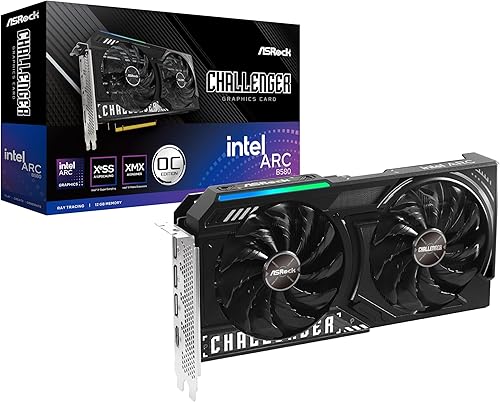
ASRock Intel Arc B580 Challenger 12GB OC Graphics
As an Amazon Associate we earn from qualifying purchases. Product prices and availability are accurate as of the date/time indicated.
Pros
- Excellent 1080p and 1440p gaming performance with DLSS 4 and ray tracing
- Cool and quiet WINDFORCE dual fan thermal design even under load
- Compact and lightweight build for easy installation in smaller cases
- Future ready with GDDR7 memory and PCIe 5.0 support
- Factory overclocked for extra performance without manual tuning
Cons
- 8GB VRAM may require settings adjustments in demanding AAA titles and heavy creative apps
- 128-bit memory interface offers less bandwidth than higher tier RTX 50 series cards
- May require a clean driver install with DDU when upgrading from older GPUs
The GIGABYTE GeForce RTX 5060 WINDFORCE OC 8G is a Blackwell powered graphics card built for gamers and creators who want next generation performance without a flagship footprint. It is ideal for 1080p and 1440p gaming, esports competition, and AI accelerated creative work that benefits from ray tracing and DLSS.
In real world use it delivers smooth, high frame rates with DLSS 4 and enhanced RT and Tensor Cores, with users reporting over 250 FPS in competitive titles and strong results in Cyberpunk and DOOM. The 8GB of ultra fast GDDR7 memory clocked at 28000 MHz and a factory boost clock of 2512 MHz provide responsive gameplay and support for resolutions up to 7680x4320.
Build quality is a highlight thanks to the proven WINDFORCE dual fan cooling system. The compact 7.83 inch card weighs just 1.6 pounds, runs cool and quiet under load, and installs easily via PCIe 5.0 x16 with DisplayPort and HDMI outputs. The clean, sleek shroud fits well in most mid tower builds.
There are some limitations to consider. The 8GB VRAM and 128 bit bus handle most modern games well but can require texture or settings management in the most demanding AAA titles. A few users also reported driver conflicts when upgrading from older cards, so a clean install using Display Driver Uninstaller is recommended.
Overall, the RTX 5060 WINDFORCE OC is a compelling mainstream upgrade that balances efficiency, thermals, and modern features. If you want quiet operation, a compact size, and access to DLSS 4 for future proof gaming, this card is an excellent choice for most gaming desktops.
Model: GIGABYTE GV-N5060WF2OC-8GD, GeForce RTX 5060, NVIDIA Blackwell Architecture
Memory: 8GB GDDR7, 128-bit interface, 28000 MHz memory clock
Clock Speed: 2512 MHz boost clock, factory overclocked
Interface: PCI-Express 5.0 x16, DisplayPort and HDMI outputs, max resolution 7680x4320
Cooling and Size: WINDFORCE dual fan cooling system, 7.83 x 4.57 inches, 1.6 pounds, 2 fans
Compatibility: Desktop PCs, dedicated graphics, 3 year manufacturer warranty
Pros
- Excellent 1440p performance with generous 12GB VRAM for modern games
- Very quiet and cool operation with 0dB fan stop technology
- Strong value compared to high priced flagship GPUs
- XeSS 2 upscaling and AV1 encode support for gaming and content creation
- Solid build quality with metal backplate and compact 2-slot design
Cons
- Intel Arc drivers still maturing, occasional game compatibility or shading quirks reported
- Requires 650W power supply and 249mm case clearance, check fit before purchase
- HDMI 2.1 support limited on Linux and no CEC support
The ASRock Intel Arc B580 Challenger 12GB OC is a mid-range graphics card built on Intel's Xe2-HPG architecture, designed for gamers targeting smooth 1080p and 1440p performance. It is ideal for budget conscious builders, casual creators, and anyone wanting modern features without paying flagship prices.
In real world use, the factory overclock to 2740 MHz and 19 Gbps memory delivers consistently high frame rates in demanding titles, with users reporting stable, stutter free gameplay at 1440p ultra settings. Support for Xe Super Sampling 2 and 160 XMX AI engines boosts performance further, while 12GB of GDDR6 on a 192-bit bus handles high resolution textures and AV1 encoding with ease.
ASRock's dual fan design with striped axial fans and 0dB Silent technology keeps the card cool and virtually silent under light loads, and the metal backplate with thermal pads adds rigidity and heat dissipation. At 249mm long with a 2-slot footprint and single 8-pin power connector, it fits most mid-tower cases and installs easily.
There are a few caveats to consider. Intel's Arc drivers have improved greatly but can still show occasional shading quirks or compatibility issues with less common games, and Linux users may find HDMI 2.1 support incomplete. You will also need a 650W power supply and to verify case clearance before buying.
Overall, the B580 Challenger offers outstanding value, combining strong 1440p performance, generous VRAM, and creator friendly features in a quiet, well built package. If you want reliable high refresh gaming and future ready connectivity at a sensible price, this is one of the smartest mid-range choices available.
GPU: Intel Arc B580, Xe2-HPG Architecture, 160 XMX Engines, 2740 MHz Boost Clock
Memory: 12GB GDDR6, 192-Bit Bus, 19 Gbps Memory Speed
Interface: PCI Express 4.0 x8, 1x 8-pin Power Connector, 650W PSU Recommended
Cooling: Dual Fan with Striped Axial Design, 0dB Silent Operation, Metal Backplate with Thermal Pad
Connectivity: 3x DisplayPort 2.1, 1x HDMI 2.1a, Supports 4 Displays up to 7680 x 4320
Dimensions: 2-Slot Design, 249mm Length, 999g Weight
Features: XeSS 2 Support, AV1 Encode, LED Indicator, Super Alloy Construction
How They Compare
VRAM Capacity and Memory Subsystem
The most obvious difference is memory. The ASRock Intel Arc B580 Challenger 12GB OC Graphics ships with 12GB of GDDR6 on a 192-bit bus running at 19 Gbps, while the GIGABYTE GeForce RTX 5060 WINDFORCE OC 8G Graphics uses 8GB of GDDR7 on a 128-bit interface. On paper that gives the Arc card more capacity for large texture packs and more raw bus width, while the RTX card relies on newer GDDR7 to keep bandwidth efficient despite the narrower bus.
For 1440p gaming, that capacity gap matters as you raise texture quality and enable extra effects. Owners commonly report that 12GB provides more comfortable headroom for upcoming titles that stream high resolution assets, while 8GB remains capable for most current games at high settings if you manage texture options. If you keep cards for several years or you play titles known for heavy VRAM use, the extra 4GB on the Arc B580 is a tangible advantage. If you upgrade more often and prefer to lean on upscaling, the RTX 5060 configuration is still well suited to 1440p.
Architecture and Feature Set
The GIGABYTE GeForce RTX 5060 WINDFORCE OC 8G Graphics is powered by NVIDIA Blackwell architecture and DLSS 4, with PCIe 5.0 support and the WINDFORCE cooling system. That positions it inside NVIDIA broader ecosystem, where DLSS Super Resolution, Frame Generation and related AI features are widely supported in new releases. The ASRock Intel Arc B580 Challenger 12GB OC Graphics is built on Intel Xe2-HPG architecture with 160 XMX engines for AI acceleration and supports Xe Super Sampling 2, or XeSS 2, plus a 2740 MHz GPU clock and 19 Gbps memory clock for responsive 1080p and 1440p performance.
In practice, your choice here reflects which upscaler and driver stack you prefer to live with. If you value broad game integration for DLSS 4 and you already use NVIDIA features for streaming or creation, the RTX 5060 will feel familiar. If you want an alternative that still offers modern AI upscaling through XeSS 2 and you appreciate Intel recent driver progress, the Arc B580 gives you a competitive toolkit. For more context on where these cards sit in the stack, see our Graphics Cards archive and our guide to top RTX 5070 ti cards for 1440p gaming to understand the step up above this tier.
Power Draw and PSU Guidance
Power and connectors are another clear split. ASRock specifies the Arc B580 Challenger as a 2-slot card that requires one 8-pin power connector and a 650W power supply, which makes planning straightforward. GIGABYTE lists the RTX 5060 WINDFORCE OC 8G Graphics as a PCIe 5.0 card with WINDFORCE cooling, but does not publish a wattage recommendation in the data we reviewed, so you should follow the guidance on the card or PSU documentation that ships with your unit.
As a general rule, give yourself headroom above the combined draw of your CPU and GPU, and follow the GPU maker recommended wattage rather than trying to cut it close. A quality 650W unit as suggested for the B580 is a sensible baseline for either card in a midrange build, with more headroom if you run a high power CPU or many drives and fans. Handle power connections with care, seat the 8-pin fully until it clicks, and follow anti-static precautions. If you are reusing an older PSU, verify it has the required 8-pin lead and that it meets modern ATX standards.
Physical Size, Cooling and Case Fit
Fit is where the Arc B580 is unusually transparent. ASRock lists a 249mm length, 2-slot width and a dual-fan cooler with 0dB Silent operation that stops the fans at low temperatures for quiet idle. It also includes a multiple-color LED indicator for a subtle accent. The GIGABYTE GeForce RTX 5060 WINDFORCE OC 8G Graphics uses the WINDFORCE cooling system and is described as a dual-fan design as well, but no exact length or slot count is provided in the data we have, so you will want to check the retailer listing for your specific chassis clearance.
Before you buy, measure your case GPU clearance, check front radiator or drive cage interference, and confirm that your case can supply fresh intake air to a dual-fan cooler. A 249mm card like the Challenger fits many compact mid-towers, which is helpful if you are working in a smaller chassis. For either card, follow the manufacturer mounting instructions, secure the bracket screws evenly, and ensure the card is fully seated in the PCIe slot. If you are planning a full system on a budget, our ryzen 5 7600 RX 7700 XT 1000 dollar gaming PC amazon build and Budget Build Guides can help you balance case, PSU and GPU choices.
Which One Should You Get
Choose the GIGABYTE GeForce RTX 5060 WINDFORCE OC 8G Graphics if you prioritize NVIDIA ecosystem features and efficiency at 1440p. You will appreciate Blackwell architecture with DLSS 4 support, PCIe 5.0 compatibility for newer platforms, and the WINDFORCE cooler that is tuned for steady operation under load. This is the more premium choice for players who want wide upscaler support in new releases, who stream or create with NVIDIA tools, and who plan to pair the card with a recent Intel or AMD platform where PCIe 5.0 is available. If your library leans on DLSS-supported titles and you value that integration, this card fits your build.
Choose the ASRock Intel Arc B580 Challenger 12GB OC Graphics if you want more VRAM headroom and a compact, quiet dual-fan design for 1440p. The 12GB GDDR6 on a 192-bit bus at 19 Gbps, combined with a 2740 MHz GPU clock and 160 XMX engines for XeSS 2, gives you extra texture capacity and modern upscaling without moving to a higher tier. The 2-slot, 249mm footprint with 0dB Silent operation is friendly to smaller cases, and the single 8-pin plus 650W guidance keeps PSU requirements simple. If you keep your GPU for several years, play texture-heavy titles, or want to maximize value while staying at 1440p, this card is the practical pick.
Who Should Skip Both
These two options are not ideal for buyers chasing high refresh 4K or heavy ray tracing at max settings, and they are not a good fit if you need a low-profile or single-slot card for a slim office chassis. If you game at 4K on a high refresh display, or you need workstation-class drivers and large frame buffers for professional creation, you should look a tier or two higher. Likewise, if your case cannot clear a dual-fan cooler or your PSU lacks a reliable 8-pin lead and adequate headroom, neither card is the right choice until you address case and power first.
Frequently Asked Questions
Is 8GB enough for 1440p gaming or do I need the 12GB Arc B580?
8GB is still capable for many current games at 1440p, especially when you use upscaling and sensible texture settings, which is where the GIGABYTE GeForce RTX 5060 WINDFORCE OC 8G Graphics with GDDR7 excels. If you prefer to max textures and keep the card for several years, the 12GB on the ASRock Intel Arc B580 Challenger 12GB OC Graphics provides more headroom and can reduce the need to compromise on texture quality in future titles.
What is the difference between DLSS 4 on the RTX 5060 and XeSS 2 on the Arc B580 for 1440p?
DLSS 4 on the RTX 5060 and XeSS 2 on the Arc B580 both use AI acceleration to boost performance at 1440p, with the RTX card leveraging Blackwell and the Arc card using 160 XMX engines. DLSS currently enjoys broader integration across new releases, while XeSS 2 is expanding and is well regarded where supported. Your preference may come down to which upscaler is available in the games you play most.
Will the Arc B580 fit in a compact case better than the RTX 5060 WINDFORCE?
The ASRock Intel Arc B580 Challenger 12GB OC Graphics is listed at 249mm long and 2 slots wide with a dual-fan 0dB Silent cooler, so it fits many compact mid-towers. GIGABYTE does not publish exact dimensions for the WINDFORCE OC model in the data we reviewed, so you should verify length and slot clearance on the retailer page and compare it to your case spec sheet before ordering.


Write Your Review
No reviews yet. Be the first to share your experience!